
Union Parish Criminal History Checks
Start with the event and the agency that made the record. The Union Parish Sheriff holds its own offense and arrest reports. The Police Jury-operated Union Parish Detention Center holds booking and current-custody details. The Union Parish Clerk of Court maintains filed Third Judicial District Court cases. Louisiana State Police BCII maintains the state criminal-history repository, but Louisiana does not offer an unrestricted public statewide name search.
Use a full legal name, date of birth when an official channel permits it, spelling variants, an incident date, and any report or case number. A broad name match is only a lead. Compare dates, court, charge, and final disposition before treating two entries as the same matter.
- Identify whether the needed item is a police report, booking, court case, or personal state record.
- Ask the creating office first and give the narrow facts that identify the event.
- Check the clerk once a prosecution has been filed in Third Judicial District Court.
- Compare the booking charge with the district attorney's filed charge and the clerk's disposition.
- Order a certified disposition or use the State Police review process when official proof is needed.
Three Union Parish Records, One Arrest
A single arrest can produce three different records. Intake at the detention center records custody, booking identifiers, the arresting agency, stated charges, and bond. A later court file records the charge the district attorney actually chose to pursue, along with minutes, pleadings, judgment, and sentence. The BCII record groups fingerprint-supported arrest cycles with dispositions reported back through the criminal-justice system.
| Record | Best question | Official custodian |
|---|---|---|
| Booking | Was the person received into local custody? | Union Parish Detention Center |
| Court case | What was filed and how did it end? | Union Parish Clerk of Court |
| State history | What fingerprint-supported Louisiana cycles were reported? | Louisiana State Police BCII |
These products should be compared, not blended. A booking charge can differ from the bill of information, and a state entry can lag a verified court disposition.
Official Background Checks in Louisiana
The Louisiana Department of Public Safety and Corrections, Public Safety Services, through State Police BCII, is the central repository. Its background-check guidance explains the official routes. The Internet Background Check system is an authorized-agency portal, not a public name-search service open to anyone. A person who wants to inspect their own Louisiana record should use the State Police review process.
Fingerprint processing runs through BCII and approved official channels. The correct form, location, eligibility rule, appointment, and charge depend on the statutory purpose, so those details should be confirmed with State Police before fingerprints are taken. An FBI Identity History Summary is a separate federal self-record channel and does not replace Union Parish court research.
Union Parish Courthouse Record Offices
The Union Parish Courthouse at 100 East Bayou Street in Farmerville concentrates three distinct functions. The Clerk of Court in Suite 105 keeps the criminal case file. Third Judicial District Court uses Suite 202 for proceedings. The Third Judicial District Attorney's Union office is in the same complex and decides what charge to file, but the DA is not the routine custodian of filed pleadings and minutes.
The official Union Parish Clerk website shows the local office that anchors this court-record route.
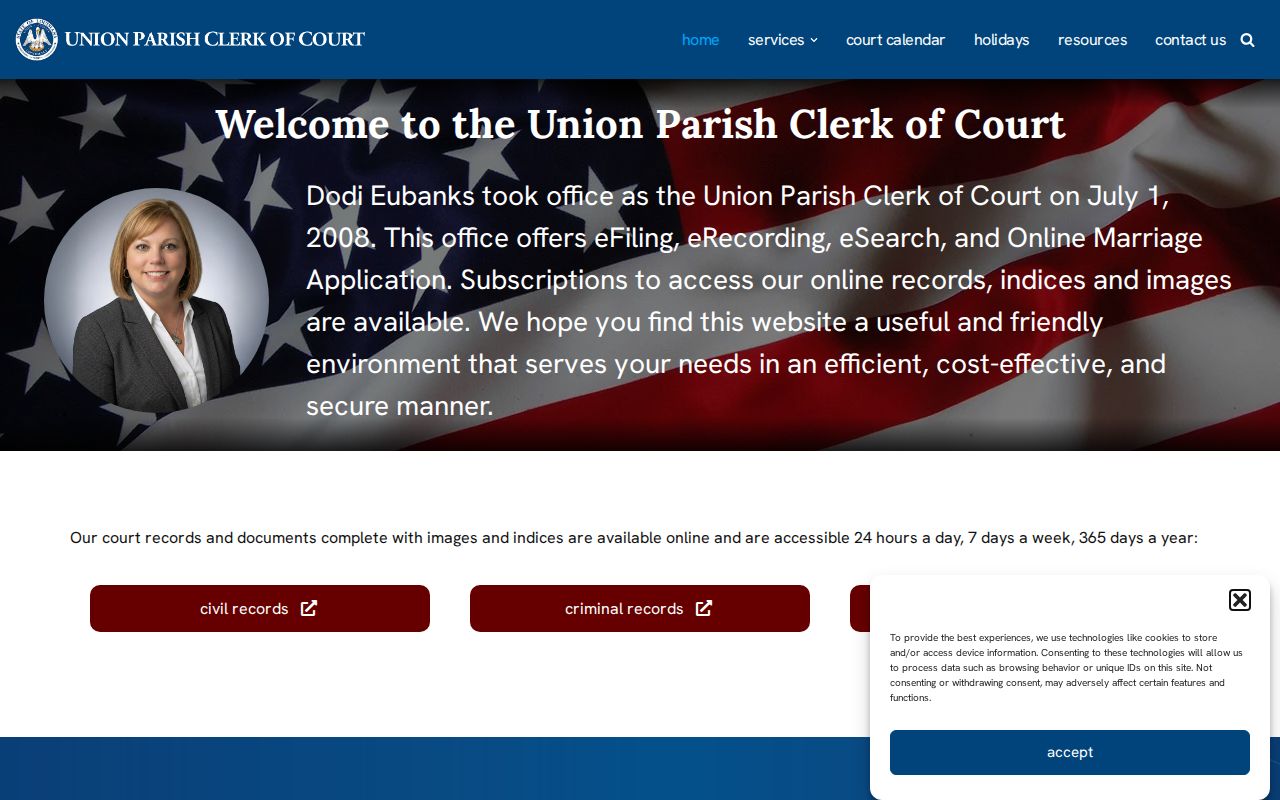
The captured page confirms the clerk as the starting point; case-specific availability and certified-copy details still require direct confirmation.
Clerk Criminal Department
100 East Bayou Street, Suite 105, Farmerville, LA 71241
(318) 368-8026
Weekdays, 8:30 a.m. to 4:30 p.m.
Third Judicial District Court
100 East Bayou Street, Suite 202, Farmerville, LA 71241
(318) 368-9734
Interpreter request resources are available.
District Attorney, Union Office
100 East Bayou Street, Farmerville, LA 71241
(318) 368-2201
Charging and prosecution records have a separate request route.
Specific case questions and official requests should go by phone rather than the clerk's general web message form. Confirm courthouse security, parking, and recording rules before a visit because the official sources reviewed do not publish those details.
Kinds of Union Parish Criminal Records
The right Union Parish criminal record depends on the event and stage. The arresting agency writes the incident or arrest report. The detention center creates a booking entry. The district attorney makes the filing choice. The clerk records the district-court case. State Police BCII receives qualifying fingerprint and disposition data, while DPSC handles state custody and supervision information.
- Police and sheriff reports: narratives and agency actions held by the office that created them.
- Booking records: custody intake, charge and bond data held by the detention operation.
- Court files: charging papers, docket activity, minutes, rulings, disposition and sentence.
- Warrants: agency or court process that must be confirmed with the responsible office.
- Registry and supervision records: limited public information governed by separate state systems.
The dedicated Union Parish court case lookup explains the local criminal portal and certified dispositions. Current arrest routes are detailed in the arrest page.
Union Parish Clerk Connect Limits
The Clerk's current criminal-record button routes to Clerk Connect. The clerk says the subscription service supplies criminal index information and document images with printing. Anonymous inspection was blocked by JavaScript and subscription controls, so no unseen search fields should be assumed. The current criminal button is more useful than relying on an older conversion notice.
| Channel | What is known | Limit |
|---|---|---|
| Clerk Connect | Criminal index and document image access through subscription | Vendor terms and authenticated interface control fields |
| eClerks LA | Remote access route used for other clerk records and statutory electronic minutes | Not a promise of every pleading or image |
| Clerk counter or phone | Specific case questions, copies, and certification | Call first for availability and cost |
Official court calendars are separate color-coded images. They can confirm a known setting but are not a party-name case index. Criminal minutes are verified before public release, which can create a short delay without changing the underlying access rule.
Union Parish Criminal Records: What They Contain
No one record contains the whole story. Identifiers help distinguish people with similar names. Arrest and booking fields describe intake. Charges should be read with the cited law and the filing stage. A disposition states the result, while a sentence states the court-ordered consequence. Custody and supervision status may come from a separate agency.
| Name and identifiers | Legal name, aliases, birth information, identifying numbers, and physical descriptors when lawfully released. |
|---|---|
| Arrest and booking | Arresting agency, date, intake identifiers, stated charge, bond, and release or transfer information. |
| Charges and statutes | Booked allegations or filed counts with Louisiana citations; the two may not match. |
| Disposition | Dismissal, plea, verdict, or other final court result shown in the verified clerk record. |
| Sentence | Custody, suspended time, probation, fines, or other conditions ordered by the court. |
| Custody or supervision | Local detention, DPSC imprisonment, probation, or parole information available under that system's rules. |
Rodeo Circle and Holder Road Records
The Union Parish Detention Center is at 707 Rodeo Circle and its custody line is (318) 368-9827. The Union Parish Police Jury operates the facility through a jail commission. The Sheriff's Office at 710 Holder Road is nearby, but UPSO expressly states that it does not operate the jail. That split controls where a request belongs.
Call the detention center for current custody, charge, and bond information. Contact the Sheriff for UPSO-created reports, Third Judicial District bonds handled there, and law-enforcement inquiries. UPSO directs readers to its official mobile app for booking photographs. The app is an access channel, not proof that the person was convicted.
After a transfer to state custody, use the Louisiana DPSC Imprisoned Person Locator or its phone route. Louisiana victim notification through VINE is useful for status alerts, but neither source is a full parish arrest-history index.
Louisiana Public Access Laws
Louisiana Public Records Law generally allows inspection or copying of existing nonexempt records held by public bodies. It does not force an office to create a new answer. Criminal-history dissemination, electronic court access, expungement, and registry information each have more specific rules. Direct a narrow request to the office that actually holds the document.
Key statutes:
La. R.S. 44:1 defines public records and the public bodies that hold them.
La. R.S. 15:587 limits dissemination of BCII criminal-history information to authorized routes.
La. R.S. 13:5992 requires defined electronic access to criminal minutes or summaries for cases filed from January 1, 2020.
Code of Criminal Procedure art. 973 makes an expunged record confidential while preserving access for listed recipients.
La. R.S. 15:587 governs BCII release and does not create a public LACCH name search.
Send Union Parish Requests to the Custodian
The Sheriff's Records Division accepts requests by mail, email, phone, or in person. Identify the report type, approximate incident date and time, location, report or complaint number if known, involved parties, and desired delivery format. Ask first whether UPSO created the record. A Farmerville, Bernice, Marion, State Police, jail, clerk, or DA record stays with its own custodian.
UPSO's published fee schedule lists letter-size black-and-white paper copies at 25 cents per page, legal-size copies at 50 cents, certification at $5, and digital records at actual reproduction cost. The office may require advance payment when estimated charges exceed the statutory threshold described in its policy. Inspection of nonexempt records is a different option from ordering copies.
| Request item | Published charge |
|---|---|
| Letter-size black-and-white copy | $0.25 per page |
| Legal-size copy | $0.50 per page |
| Certification | $5 |
| Digital reproduction | Actual reproduction cost |
Restricted, Sealed and Expunged Records
Louisiana expungement under Code of Criminal Procedure arts. 971 through 996 generally removes an eligible record from public access; it does not destroy every agency copy. Statutorily listed agencies and recipients can retain access in defined circumstances. Juvenile files, victim information, investigative material, and other protected content may also be sealed, withheld, or redacted under separate rules.
Eligibility differs for a nonconviction, misdemeanor, and felony. Articles 976, 977, and 978 contain different paths and exclusions. Article 983 caps the ordinary total fee at $550, divided among BCII, the sheriff, district attorney, and clerk, while listed exceptions can change what is owed. Louisiana uses mandatory motion and order forms. A person should confirm the correct article, form, fee, and filing court rather than assume a dismissal erased the arrest.
If a BCII self-record lacks the final result, compare it with a certified Union Parish disposition and follow the State Police review or challenge process. Updating one system does not automatically rewrite every older copy held elsewhere.
Union Parish Distance Changes Record Access
Union Parish spans 876.90 land square miles and had an estimated 20,561 residents in 2025. Household broadband was reported at 64.1 percent for the 2020 to 2024 profile. In a rural parish of about 24 people per square mile, phone, app, and remote channels are practical parts of access, not mere conveniences.
Call before driving to Farmerville, especially when a file may still be under verification or held by a municipal agency. The parish also borders Arkansas. A Union Parish file will not reveal an Arkansas prosecution, and Louisiana's state history is not a national court search. Federal matters in the parish belong to the Western District of Louisiana and PACER, while federal custody uses the Bureau of Prisons locator.
Crime statistics should be checked by agency and year through the FBI Crime Data Explorer. A blank year can mean nonparticipation or missing reporting, not zero crime, and small-town rates can swing sharply from a few events.
City-by-City Criminal Records in Union Parish
Farmerville, Bernice, and Marion each create municipal police and court records before some matters move to parish custody or Third Judicial District Court. Official 2024 estimates rank the towns at 3,375, 1,304, and 601 residents. Each local route begins with the town office that made the report, then follows the record to the detention center or clerk when needed.
Farmerville Record Check
Population 3,375. Start with the police department or Town Hall for local reports and mayor's-court records.
Bernice Record Check
Population 1,304. Bernice Police accepts direct phone, email, fax, and counter contact.
Marion Record Check
Population 601. Town records distinguish Marion Municipal Court from Ward 2 Justice of the Peace.
Read Union Parish Case Terms Carefully
Louisiana criminal files use terms that describe a filing or court action, not a simple guilty-or-not label. Reading the minute entry with the charging paper and judgment avoids false conclusions. The clerk can supply a certified disposition when an abbreviated online entry is not enough.
- Bill of information
- A charging document filed by the district attorney for an offense pursued in court.
- Capias
- A court order directing that a person be taken into custody; current status must be confirmed officially.
- Nolle prosequi
- The prosecutor's formal decision not to proceed with a charge at that point.
- Minute entry
- The clerk's verified record of what occurred during a court setting.
- Disposition
- The recorded result of the charge, which may differ from the allegation shown at booking.
Louisiana also does not use a universal Class A, B, or C system. A felony is an offense punishable by death or imprisonment at hard labor; a misdemeanor is another offense for which imprisonment may be imposed. Penalties remain offense-specific.
Union Parish Warrants and Supervision
Crime Stoppers is not a warrant lookup. The Sheriff's 24-hour anonymous tip line and form collect information about suspected offenses, but a tip neither confirms nor clears a warrant. For a possible sheriff warrant, contact UPSO. A bench warrant issued in a filed case may also appear through the clerk's minute record. Anyone resolving their own warrant should verify status through the responsible office and obtain legal advice where needed.
Adult probation and parole are state-run through Louisiana DPSC. A public court minute can confirm that a Union Parish sentence included probation, while nonpublic supervision details may remain with the agency. The DPSC imprisoned-person locator is for the state sentenced population, not every recent local booking. Those boundaries explain why a complete search can require several official systems.