
Criminal Court Cases in Union Parish
Third Judicial District Court hears Louisiana felony and other state-law criminal matters within district-court jurisdiction for Lincoln and Union Parishes. Union Parish matters are heard at 100 East Bayou Street, Suite 202, Farmerville, with courtroom inquiries at (318) 368-9734. The district attorney decides what state charge to file. The elected Clerk of Court preserves the filed case and its verified minutes.
The Clerk’s criminal counter is in Suite 105 of the same courthouse. Farmerville, Bernice, and Marion maintain separate local channels for municipal ordinance matters, and Justice of the Peace courts have limited jurisdiction. A city citation is not automatically a Third JDC case. Federal prosecutions belong to the Western District of Louisiana and do not live at the Union Parish Clerk.
Union Parish Clerk Criminal Desk
The Clerk’s courthouse counter is the direct source for official Union Parish court records. It is open weekdays from 8:30 a.m. to 4:30 p.m. Call (318) 368-3055 for the main office or (318) 368-8026 for the minute clerks; the criminal fax is (318) 982-8012. The official contact page tells people with specific case questions or official requests to call during business hours instead of using the general message form.
Use a case number when known. Otherwise give the full name and an approximate filing or arrest year, then compare the caption, court, charge, and dates. A similar name alone is not proof of identity. Ask for a certified disposition when the final result must be matched to a Louisiana State Police self-review record.
Union Parish County Case Record Searches
The Clerk’s current criminal-record button points to Clerk Connect, a subscription route for criminal index information and available document images or printing. Its authenticated fields, subscription price, and download charges were not exposed in the research, so confirm current terms with the Clerk. Online Services, eClerks LA availability, telephone help, and the counter form a practical fallback chain for older files and certified copies.
- Open Union Clerk Online Services and follow the current criminal-record link to Clerk Connect.
- Search by case number when possible; otherwise use the party name supported by the live service.
- Narrow by criminal case type, filing year, date range, court, or parish when those fields appear.
- Read the docket and minute entries count by count, and distinguish a pending charge from a disposition.
- Call the Clerk for older records, unavailable images, official copies, certification, and current fees.
| Field Label | Type | Required | Notes |
|---|---|---|---|
| Name or party | Text | Portal-dependent | Enter the surname accurately and confirm the match from other details. |
| Case number | Text | Optional alternative | Best discriminator; preserve the Clerk’s displayed punctuation. |
| Date or year range | Date/select | Optional | Narrows a common name or archived period. |
| Record or case type | Select | Optional | Choose criminal when that option is available. |
| Court or parish | Select | Portal-dependent | Select Union Parish or Third JDC in a multi-jurisdiction service. |
Union Parish Electronic Court Minutes
Louisiana R.S. 13:5992 requires a public electronic minimum of criminal minute entries or summaries for cases filed from January 1, 2020. It does not promise every pleading, exhibit, or image online. eClerks LA can indicate remote availability, while the Union Clerk’s current criminal button still routes to Clerk Connect. Follow the current button when an older conversion notice conflicts with it.
Criminal minute clerks record court events, swear jurors and witnesses, retain introduced evidence, and process notices and bench warrants. The Clerk says minutes become public after diligent verification. A short delay can reflect that process. Call the minute clerks for a time-sensitive result instead of reading an absent electronic entry as proof that no event occurred.
What a Criminal Case File Contains
A Union Parish criminal file follows the prosecution from the charging instrument through the final recorded action. Read every count separately because one charge can be amended or dismissed while another ends in conviction. A status label is shorthand. The minute entry, judgment, and sentence provide firmer context.
| Case Number & Court | The unique file identifier, district, and division. |
|---|---|
| Charging Document | Complaint, bill of information, or indictment with statutes and counts. |
| Docket Entries | Filed motions, appearances, continuances, rulings, and minute events. |
| Hearing Dates | Past and scheduled settings, with judge when public. |
| Disposition & Judgment | The result for each count, including conviction, dismissal, or acquittal. |
| Sentence & Conditions | Confinement, probation, fines, costs, or restitution when public. |
Union Parish Calendars Are Not Case Search
The Clerk publishes current color-coded court calendar images. They help confirm a known setting but do not work as a party-name database and do not show the full case history. A calendar can change after publication. Use the docket and verified minutes for what happened, and confirm a near-term appearance with the Clerk or Third Judicial District Court.
A missing name on the current calendar does not show that no case exists. It may mean the matter is set for another date, appears under a different caption, or is not on that calendar. Clerk Connect and the criminal counter answer the broader case-record question.
Criminal Case Stages in Union Parish
After arrest and booking, the district attorney decides whether and what to file. Arraignment records the plea. Pretrial minutes can show counsel, motions, continuances, and hearing settings. A plea or trial leads to an outcome; conviction proceeds to sentence. Later motions, probation issues, and appeal notices may add entries. No uniform local timetable was published, so use the actual docket.
Case flow: Charges Filed › Arraignment › Pretrial › Plea or Trial › Disposition › Sentencing
Choosing the Right Union Parish Court
A Farmerville mayor’s-court citation for an ordinance violation is not a Third JDC felony file. Farmerville’s local channel runs through Town Hall at 1024 Sterlington Highway, (318) 368-9242. Bernice ordinance matters should be confirmed through the town clerk at (318) 285-9071. Marion’s official minutes reference municipal court and Ward 2 Justice of the Peace court, and current details should be confirmed with the town.
The Union Clerk is still the correct record holder when a town officer’s arrest leads to a state prosecution in Third JDC. For federal charges, use PACER and the Western District of Louisiana. The parish Clerk cannot supply the complete federal docket or an Arkansas case.
Access Rules for Case Records
Louisiana Public Records Law generally opens existing nonexempt records to inspection or copying, while specific confidentiality laws control. Juvenile material, protected victim details, personal identifiers, active investigative information, and sealed or expunged records may be withheld or redacted. Grand-jury deliberations do not become public merely because a later indictment appears.
Online access can be narrower than the courthouse file. If a Union Parish case is absent, ask whether it is older, archived, under another spelling, awaiting verified minutes, or restricted. The Clerk can explain access and available certification, but the research found no posted plain-copy or certified-copy fee. Confirm cost before ordering.
Public access also depends on asking for the right product. A court file can contain public pleadings and minutes even though Louisiana does not offer an unrestricted public LACCH name search. Conversely, access to a local docket does not authorize release of protected state repository data. Describe an existing record rather than asking the Clerk to research a person or create a new summary.
Union Parish Certified Dispositions
A certified disposition shows how a filed charge ended. Request it from the Clerk rather than the Sheriff or detention center. Supply the case number, full name, approximate year, and arrest cycle that must be matched. Ask that every count, amendment, final result, and sentence be covered. A dismissal is not the same as an acquittal, and nolle prosequi means the prosecutor abandoned the charge at that time.
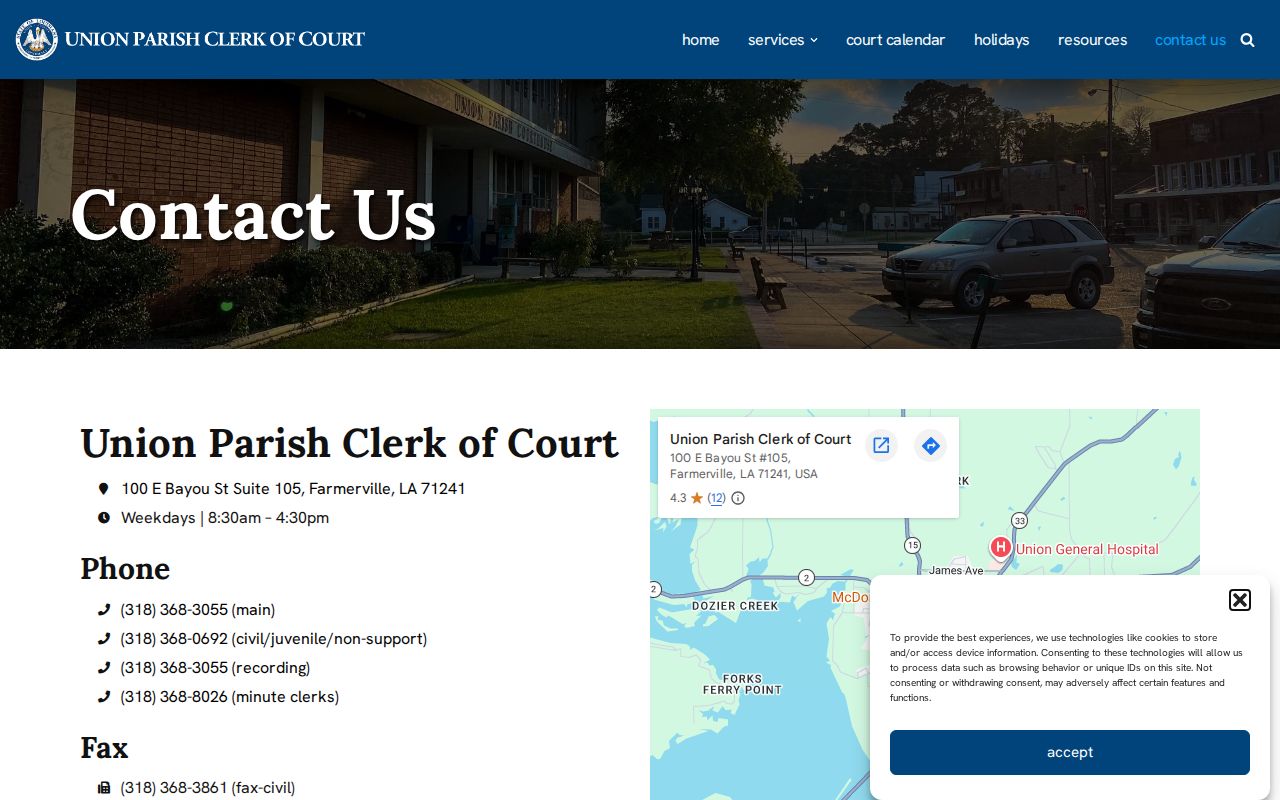
The official Clerk contact page shown below identifies the courthouse route for detailed case questions and official requests.
If a Louisiana State Police self-review record lacks the outcome, retain the certified disposition and follow BCII review or challenge instructions. Updates between the court and repository may not be immediate.
Check the certified paper against the arrest date, original booked allegations, filed counts, and disposition date. An arrest cycle and a court case can use different numbers, so those dates and charge details help BCII connect the correct event. If several counts were filed, make sure the document states the outcome of each one rather than stopping at the first listed charge.
Union Parish also has a Third Judicial District Attorney office in the courthouse complex at 100 East Bayou Street. That office controls prosecutorial charging decisions and publishes its own public-record request route, but the Clerk remains the ordinary custodian for filed pleadings and minutes. Prosecutor work product and active investigative material may be exempt even when a document filed in open court can be obtained from the Clerk.